Learn the first 4 things to do when your water heater leaks in Kings Mountain, NC, including how to reduce water damage, protect your subfloor, and know when to call a plumber.
My Water Heater Is Leaking — What Should I Do First?
Most people do not search for this because of a tiny drip they noticed weeks ago.
They searched for it because they just walked into the garage, utility room, or crawl space and found water around the water heater.
The short answer:
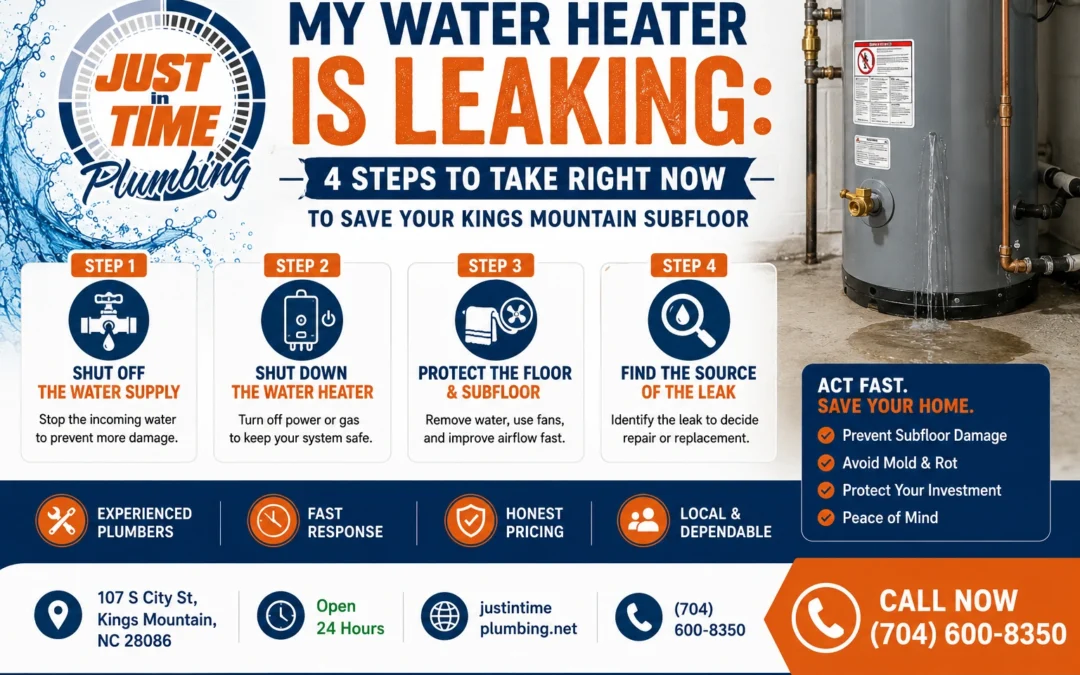
If your water heater is actively leaking, the fastest way to reduce damage is to stop the water, shut down the heater safely, protect the flooring, and get the leak evaluated before the subfloor starts soaking up water.
Around Kings Mountain, many homes have water heaters installed in garages, utility closets, basements, or crawl-adjacent spaces where leaks can quietly damage:
- Subflooring
- Baseboards
- Drywall
- Cabinets
- Flooring
- Crawl space framing
- Insulation
The first few minutes matter more than most homeowners realize.
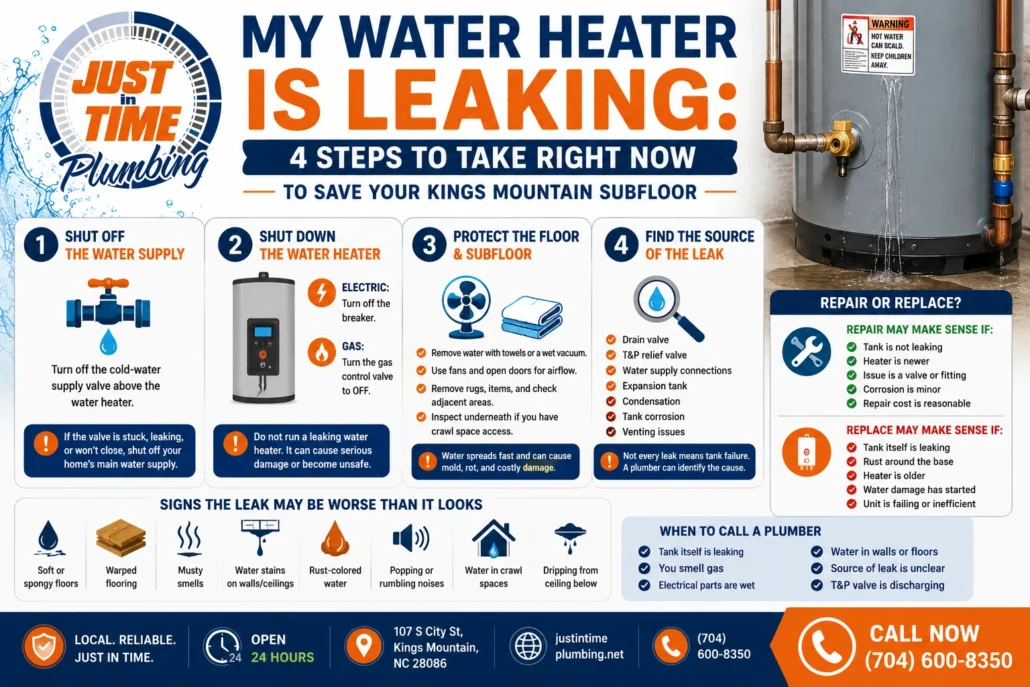
Step 1: Shut Off the Water Supply
If the leak is active, stop the incoming water first.
Most water heaters have a shutoff valve on the cold-water supply line above the heater.
Turn the valve:
- Clockwise for traditional shutoff valves
- Perpendicular to the pipe for quarter-turn valves
If the valve is stuck, leaking, or will not close completely, shut off the home’s main water supply instead.
Call a plumber now if:
- The shutoff valve breaks
- Water continues pouring from the heater
- You cannot find the shutoff
- The leak is worsening quickly
Step 2: Shut Down the Water Heater Safely
Once the water is controlled, shut down the heater itself.
For electric water heaters:
Turn off the breaker at the electrical panel.
For gas water heaters:
Turn the gas control valve to the OFF position.
Do not continue running a leaking water heater. If the tank drains while power or heat remains active, the system can become damaged or unsafe.
Important safety note:
If you smell gas at any point:
- Leave the area
- Do not flip switches
- Do not use open flames
- Call the gas company or emergency services if needed
- Contact a plumber afterward
Gas smells should never be treated casually.
Step 3: Protect the Floor and Subfloor Immediately
This is where many homeowners lose time.
Visible water on the floor is only part of the problem.
Water often spreads underneath:
- Vinyl flooring
- Laminate
- Baseboards
- Wall trim
- Utility room flooring
- Crawl space framing
The longer moisture sits, the greater the risk of:
- Swollen subfloor
- Soft flooring
- Mold growth
- Rotting wood
- Odors
- Structural damage
What to do right away:
- Use towels or a wet vacuum
- Place fans near the area
- Remove rugs or stored items
- Open nearby doors for airflow
- Check adjacent rooms for water spread
- Inspect underneath if crawl space access exists
In humid North Carolina conditions, moisture trapped under flooring can linger longer than homeowners expect.
Step 4: Figure Out Where the Leak Is Coming From
Not every “water heater leak” means the tank itself has failed.
A plumber usually checks several possible leak sources first.
Common leak locations include:
- Drain valve
- Temperature and pressure relief valve
- Water supply connections
- Expansion tank
- Condensation
- Venting issues
- Tank corrosion
This matters because some leaks are repairable while others require full replacement.
Repair May Make Sense If:
- The tank itself is not leaking
- The heater is newer
- The issue is isolated to a valve or fitting
- Corrosion is minor
- The repair cost is reasonable
Replacement May Make Sense If:
- The tank itself is leaking
- Rust is visible around the base
- The heater is older
- Water damage has already started
- Multiple components are failing
- The unit repeatedly loses efficiency
Once the actual tank shell starts leaking, replacement is usually the more realistic option.
How Fast Can a Water Heater Leak Damage a Subfloor?
Faster than most people think.
Subfloor damage depends on:
- How long the leak runs
- Flooring material
- Ventilation
- Humidity
- Whether water spreads under walls or cabinets
Even a slow leak can create long-term damage if it continues unnoticed.
This is especially true in utility closets where airflow is limited.
Signs the Leak May Be Worse Than It Looks
Call a plumber soon if you notice:
- Soft flooring
- Warped laminate or vinyl
- Musty smells
- Water stains on nearby walls
- Rust-colored water
- Popping or rumbling noises
- Water underneath the heater
- Dripping from ceiling areas below
- Moisture in crawl spaces
These often mean the leak has been active longer than expected.
What Homeowners Often Misunderstand
Many people assume the visible puddle is the full extent of the problem.
But subfloor materials absorb water quietly.
The leak may already be affecting areas you cannot easily see.
Another common misunderstanding: not every leaking water heater is an emergency replacement.
Some leaks involve:
- Loose fittings
- Faulty valves
- Expansion tank problems
- Condensation issues
A fair plumber should explain whether the tank itself failed or whether the repair is isolated.
Can You Still Use a Leaking Water Heater?
Usually, continuing to use a leaking heater is risky.
Even small leaks can suddenly worsen.
If the tank itself is compromised, pressure and corrosion may continue damaging the unit.
The safer move is usually shutting the system down until it can be inspected.
DIY vs Calling a Plumber
DIY may be reasonable if:
- The leak is minor and isolated to a simple fitting
- The water can be safely shut off
- You understand the system
- No gas line work is involved
Stop DIY and call a plumber if:
- The tank itself is leaking
- You smell gas
- Electrical components are wet
- Water spread into walls or flooring
- The leak source is unclear
- The pressure relief valve is discharging heavily
Water heaters combine:
- Plumbing
- Electrical systems
- Gas systems
- Pressure safety controls
- Hot water under pressure
That combination can become dangerous when leaks develop.
Bottom Line
If your water heater is leaking in Kings Mountain, the first priority is stopping the water and protecting the surrounding flooring before the subfloor absorbs more moisture.
The four most important steps are:
- Shut off the water
- Shut down the heater safely
- Dry and protect the surrounding area
- Identify whether the leak is repairable or tank failure
Not every leak means full replacement. But once tank corrosion starts or water spreads into flooring and framing, waiting usually makes the repair more expensive.
If you are unsure whether the leak is minor or the beginning of a larger failure, the next step is having the system inspected so you can understand the damage, repair options, and replacement costs before the problem spreads further.